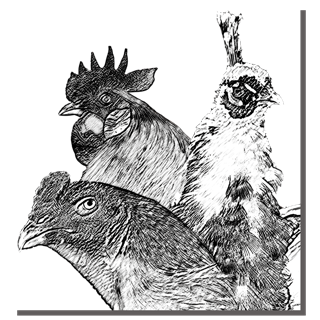
From India to my breeding
Parrot Beak Aseel have fascinated me since 2002. Even then, I knew I wanted to breed these extraordinary birds myself one day. That wish came true in 2022, when the first birds from their Indian homeland arrived with me in Germany.
Getting there took longer and proved more difficult than expected. That made the joy of finally breeding original birds of the Tamil Nadu type all the greater.
As with my Shamo, a good breeding programme develops over generations. It needs the right genetic foundations, careful selection and a willingness to shape the line through one’s own work.
A clear breeding goal is the foundation. Below, I describe the type, build and temperament I aim for.
A glimpse of my Aseel breeding
Breed description
Type and body structure
I aim for a large, lively and agile gamefowl with a traditional appearance, an exceptionally substantial head and strikingly long plumage. Good brooding qualities and strong family behaviour are equally important. The upper skull line should arch above the nostrils, carrying the male’s round, ideally smooth cushion comb.
The body is carried moderately upright. Neck, body and shanks should be balanced, each accounting for about a third. Neck and tail plumage should be abundant, yet notably hard.
The body should be firm, broad and muscular, with the back as straight as possible. Strong back muscles may give the line a slightly curved appearance, but skeletal deformity has no place in my breeding goal.
The distinctive tail plumage
The tail has a distinctive structure: long, horizontally arranged main feathers form a broad fan. They are covered by numerous narrow, hard, almost straight sickle feathers reminiscent of individual sabres. These should reach at least to the ground. The tail base follows the body line and is carried just above the ground. I set no upper limit on tail length.
Head, beak and pearl eye
The head that gives the breed its name should be round and substantial, with a large, bright pearl eye. The strong beak follows the curve of the head and must close properly.
The head carries a rounded, ideally smooth cushion comb. It is barely developed in the hen, while in the male it may form a ball-shaped rise on the forehead. Wattles are absent.
The head should appear lean, with pronounced brows despite the rounded eye shape. Shanks may be white or yellow.
Heavy Line
In 2023, I succeeded in importing the Heavy Line. Hens weigh 3–4 kg and roosters around 4.5–5.5 kg.
Brooding and young birds
Their low egg production makes breeding a challenge. A hen usually lays eight to ten eggs in a clutch before going broody. Their persistent broodiness makes this rhythm difficult to interrupt, so there are often only around three laying cycles a year.